
Early Signs of Cataract You Should Never Ignore
Most people do not notice a cataract developing. That is the truth. It does not hurt. There is no sudden change. No alarm goes off. The lens inside your eye simply begins to cloud over — gradually, silently, over months or years — until one day you realise that the world looks different from how it used to.
By the time most patients come to see me at Dr. Rishi Eye Institute, they have been living with the early signs of a cataract for longer than they realise. They thought it was ageing. They thought their glasses prescription needed updating. They thought the lighting in the room was just bad.
Understanding what a cataract actually feels like — in its earliest stages — is the difference between catching it early and managing it comfortably, or waiting until it affects your daily life significantly before doing anything about it.
What Is a Cataract — And Why Does It Develop?

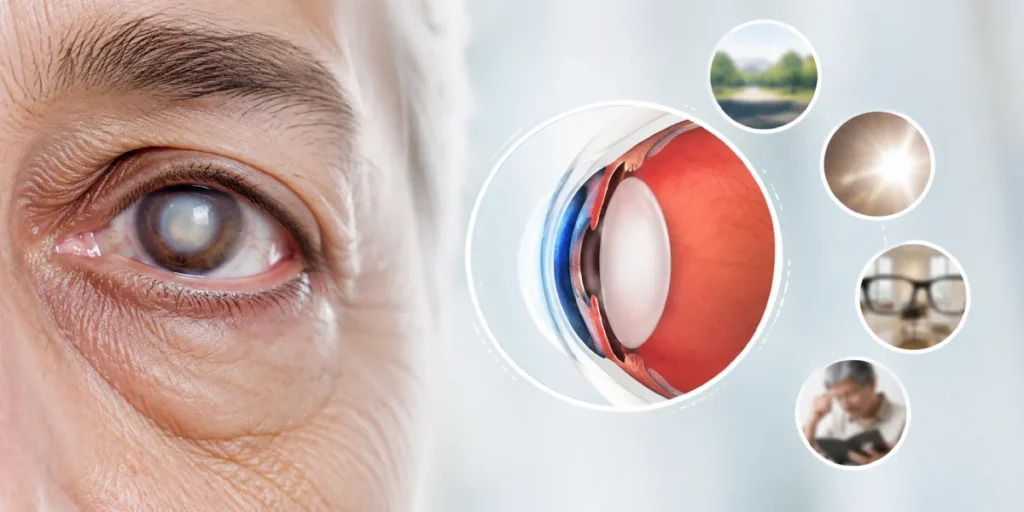
The natural lens inside your eye is normally clear — like clean glass. It focuses light precisely onto the retina at the back of your eye, giving you sharp, clear vision. A cataract develops when proteins within this lens begin to clump together and cloud over, scattering and blocking the light that passes through.
Ageing is the most common cause — the natural proteins in the lens break down over time. But cataracts can also develop earlier due to diabetes, prolonged steroid use, eye injury, or radiation exposure. Some people are even born with them.
The key thing to understand is that cataracts are not an emergency — but they are progressive. They do not improve on their own. And the earlier you are aware of what is happening, the better placed you are to manage the situation thoughtfully.
The Early Warning Signs — What to Watch For
1. Blurred or Hazy Vision That Glasses Do Not Fully Fix
This is often the very first sign — and the one most commonly dismissed. Your vision feels slightly foggy or hazy, like looking through a smudged window. You clean your glasses. The smudge is not on the lens. You get a new prescription. It helps a little but not completely.
If you find yourself in this situation — where updated glasses are not fully restoring the clarity you expect — a cataract should be one of the first things your eye doctor checks for.
2. Frequent Changes in Spectacle Prescription
One of the more surprising early signs is a prescription that seems to keep changing. You go back to your optician every few months because your vision has shifted again. This happens because the cataract is gradually altering the way your lens refracts light — changing your effective prescription in ways that no pair of glasses can keep up with permanently.
If your prescription has been changing repeatedly over a short period, especially if you are above 50, a thorough eye examination — not just a refraction test — is essential.
3. Increased Sensitivity to Glare
Bright sunlight feels uncomfortable. Oncoming headlights at night are blinding rather than simply bright. Overhead lighting in shops or offices creates an uncomfortable, washed-out effect that makes it hard to see clearly.
This happens because the clouded lens scatters incoming light rather than focusing it cleanly. The result is a sensitivity to bright light sources — particularly direct light and reflections — that is noticeably worse than it used to be.
4. Halos Around Lights at Night
Related to glare sensitivity is the appearance of halos — rings of light — around streetlights, car headlights, and other bright sources at night. You may also notice starbursting effects, where point sources of light seem to radiate outward.
Night driving in particular becomes noticeably more difficult. Many patients at Dr. Rishi Eye Institute tell me they have quietly stopped driving after dark before they fully understood why — and the reason, on examination, turns out to be a developing cataract.
5. Colors Appearing Faded or Yellowish
The clouding of the lens affects not just clarity but color perception. Once vivid colors begin to look washed out, muted, or with a yellowish or brownish tint. Whites look cream-colored. Blues may appear faded.
This change is often so gradual that patients do not notice it themselves — it is sometimes a family member who comments that the patient seems to have difficulty distinguishing between certain colors, or who notices a change in how the patient describes what they see.
After cataract surgery in Karnal, patients regularly tell me — with genuine surprise — how vivid and bright colors seem compared to what they had been seeing. Many did not realise how much the cataract had been affecting their color vision until the clear artificial lens was in place.
6. Double Vision in One Eye
Double vision is commonly associated with problems in eye alignment or nerve function — but it can also be an early sign of a cataract. When the clouded lens scatters light irregularly, it can create a second, ghost-like image alongside the main image — visible even when the other eye is closed.
If you notice double or ghost vision in one eye, this warrants prompt examination.
7. Temporary Improvement in Near Vision — “Second Sight”
This is one of the more paradoxical signs, and one that often gives patients false reassurance. Some people with developing nuclear cataracts — the type that forms in the centre of the lens — notice a temporary improvement in their near vision. They can suddenly read without their reading glasses, after years of needing them.
This phenomenon is sometimes called “second sight.” It feels like good news. It is not. It is caused by the cataract changing the refractive index of the lens in a way that temporarily improves near focus — and it is a reliable indicator that a cataract is actively developing. The improvement is temporary. It does not last.
When Should You See an Eye Specialist?

The short answer is: do not wait until your vision is significantly impaired before getting your eyes properly examined.
Many of the signs described above — hazy vision, glare, halos, color changes — are subtle enough in the early stages that people live with them for months or years without connecting them to a cataract. By the time the cataract is dense and vision is severely affected, the surgical procedure becomes more complex.
Early detection through a comprehensive eye examination allows you and your doctor to monitor the cataract’s progression and plan surgery at the optimal time — before it begins to seriously affect your quality of life. If you want to understand more about the types of cataract and how surgery is performed, our detailed guide on cataract types, symptoms and treatment covers everything in one place.
Who Is at Higher Risk of Developing Cataracts?
You are at higher risk if you are above 60 years of age, have diabetes or high blood pressure, have been on long-term steroid medication, have had a previous eye injury or eye surgery, spend significant time in strong sunlight without UV protection, or have a family history of early cataracts.
Diabetic patients in particular should have comprehensive eye examinations annually — not just for diabetic retinopathy, but for cataract development as well. Our guide on protecting vision after 50 explains how regular eye check-ups in the later decades of life can catch multiple conditions — including cataracts — before they cause significant vision loss.
Can Cataracts Be Prevented?

Not entirely — ageing is the primary cause and cannot be avoided. But certain habits can reduce your risk and slow progression. Wearing UV-protective sunglasses consistently outdoors, managing diabetes and blood pressure carefully, maintaining a diet rich in antioxidants, and avoiding smoking all contribute to better long-term lens health.
And most importantly — regular comprehensive eye examinations after the age of 50. You cannot self-diagnose a cataract reliably. You need a slit-lamp examination by an experienced eye specialist.
The Good News — Cataract Is Completely Treatable
If there is one message I want every patient to take from this guide, it is this: a cataract diagnosis is not something to fear. It is one of the most treatable conditions in all of medicine.
Modern cataract surgery in Karnal at Dr. Rishi Eye Institute is performed using phacoemulsification — a small-incision, stitch-free technique — with a range of premium lens options including multifocal and toric lenses that can correct vision at multiple distances. The procedure takes 15 to 20 minutes, and most patients go home the same day with dramatically improved vision by the next morning.
For patients eligible under Ayushman Bharat or ECHS, cataract surgery is available at our institute under these empanelments — making quality treatment accessible regardless of financial circumstance. Our complete guide on why Dr. Rishi Eye Institute is Haryana’s most trusted eye hospital explains the full range of services and empanelments available.
Final Thoughts
The early signs of a cataract are easy to dismiss — until, over time, they become impossible to ignore. Do not wait for that point.
If you have noticed any of the changes described in this guide — hazy vision, increasing glare, halos at night, color changes, or a prescription that keeps shifting — please book a comprehensive eye examination. Early detection protects your vision and keeps your treatment options open.
At Dr. Rishi Eye Institute, Karnal, we provide thorough cataract evaluation and advanced surgical care for patients across Karnal, Kurukshetra, Panipat, and Haryana.
📞 Call us: +91-7015680440 📍 1363/64, Sector-6, Karnal, Haryana – 132001

2 Comments
Cataract Lens Guide Karnal | Dr. Rishi Eye Institute
[…] and honestly — including acknowledging limitations — is one worth trusting. Our guide on early signs of cataract and when to seek treatment is a useful companion read if you are still in the process of understanding your […]
Cataract Surgery in Karnal | Dr. Rishi Eye Institute
[…] cataract, do not assume nothing can be done. Come in and get it checked. Our detailed guide on early signs of cataract and vision changes also helps you understand what different types of visual changes mean and when to seek an […]