
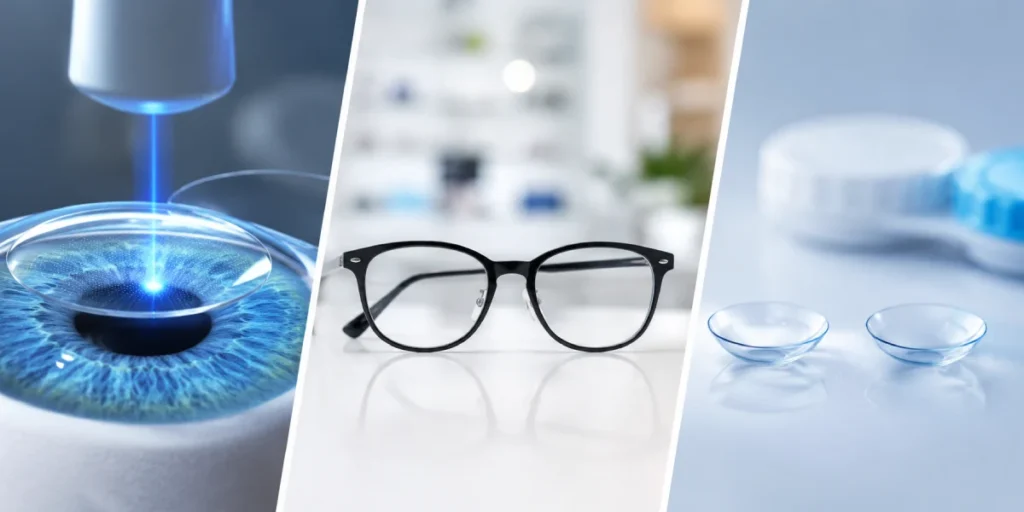
LASIK vs Glasses vs Contact Lenses: A Complete Comparison
If you wear glasses or contact lenses, you have probably had this thought at some point — usually on a rainy evening when your glasses are fogged up, or during a workout when your contacts feel like sandpaper.
Is there a better way?
The honest answer is: it depends on who you are, what your eyes look like on the inside, and what your daily life actually demands. But to make that decision properly, you need a clear, fair comparison of the three main options — glasses, contact lenses, and LASIK eye surgery in Karnal — not a sales pitch for any one of them.
That is what this guide is. Let us go through each option honestly.
Glasses — The Familiar Option

Glasses have been correcting vision for centuries, and they remain the most widely used form of vision correction in the world. There is a reason for that — they work, they are safe, and they require almost nothing from the wearer beyond putting them on and taking them off.
What glasses do well:
Glasses are easy to use and carry no infection risk. They can be put on and removed instantly. They require no touching of the eye. They can correct virtually any refractive error — myopia, hyperopia, astigmatism, presbyopia — and they can incorporate multiple prescriptions in a single lens. For people who spend significant time reading, glasses with the right lenses are still the gold standard for comfort.
Where glasses fall short:
Glasses do not correct your vision — they sit in front of it. This means they have a limited field of clear vision, peripheral distortion with strong prescriptions, and a physical presence on your face that affects appearance, comfort, and activity. They fog up in humidity and temperature changes. They slip during physical activity. They can break at the worst possible times. And over a lifetime, the cost of frames, lenses, and replacement adds up more than most people calculate.
Contact Lenses — The Active Alternative
Contact lenses brought a significant improvement in quality of life for millions of people who found glasses inconvenient. They sit directly on the cornea, correcting vision across the full visual field, and they are invisible. For many people — athletes, performers, people who simply prefer how they look without glasses — contacts were a genuine game-changer.
What contact lenses do well:
Contacts provide a wider, more natural field of corrected vision than glasses. They move with your eye, making them more comfortable during sports and physical activity. They do not fog up, do not slide down your nose, and do not interfere with headwear, sunglasses, or safety equipment. For active lifestyles, they offer freedoms that glasses simply cannot.
Where contact lenses fall short:
Contact lenses require daily discipline that many wearers underestimate. They must be cleaned, stored correctly, and replaced on schedule. Wearing them for too many hours — which students, professionals, and busy people do regularly — leads to dryness, irritation, and redness. Every contact lens wearer carries a small but real risk of corneal infection, particularly when hygiene slips during busy periods. Long-term lens wear has been associated with chronic dry eye in many patients.
The cumulative cost of contacts — lenses, solutions, cases, eye drops, and replacement packs — often surprises people when they calculate it over five or ten years.
LASIK Eye Surgery — The Permanent Solution

LASIK — Laser-Assisted In Situ Keratomileusis — permanently reshapes the cornea using a precisely controlled laser. The result is that your eye focuses light correctly without any external correction. No glasses. No lenses. Just your own vision, working as it should.
Best LASIK surgery in Karnal at Dr. Rishi Eye Institute is performed after a comprehensive pre-operative evaluation that determines whether your eyes are suitable — because LASIK is not the right choice for everyone, and identifying that before surgery is the most important part of the process.
What LASIK does well:
LASIK provides permanent correction for myopia, hyperopia, and astigmatism within treatable ranges. The procedure takes approximately 10 to 15 minutes for both eyes. Most patients notice dramatically improved vision within 24 hours. Recovery is rapid — the majority of patients return to normal activities within one to two days. Once healing is complete, the result is stable and long-lasting. The freedom from glasses and contact lenses — for sports, travel, work, social situations, and simply waking up each morning — is something patients consistently describe as life-changing.
For patients searching for LASIK surgery near me in Haryana, Dr. Rishi Eye Institute offers comprehensive evaluation, advanced laser technology, and personalized care for patients across Karnal, Kurukshetra, Panipat, and surrounding areas. Our guide on LASIK surgery — a safe and effective way to get rid of glasses explains the full procedure and recovery in detail.
Where LASIK has limitations:
LASIK is not suitable for everyone. Patients with thin corneas, significant dry eye disease, unstable prescriptions, or certain eye conditions may not be candidates. Age matters too — LASIK is generally recommended after 18, and prescription stability for at least one year is required. Additionally, LASIK corrects your vision as it is today — age-related changes such as presbyopia will still occur in later decades, meaning reading glasses may be needed after 40 regardless of having had LASIK.
For patients who are not suitable for LASIK, ICL surgery — where a lens is placed inside the eye without removing corneal tissue — is often an excellent alternative. Our detailed guide on ICL surgery for vision correction covers who this benefits most and how it compares to laser correction.
A Direct Comparison
| Factor | Glasses | Contact Lenses | LASIK |
|---|---|---|---|
| Correction Type | External | External | Permanent |
| Daily Maintenance | Low | High | None (post-healing) |
| Infection Risk | None | Moderate | Minimal |
| Sports Suitability | Limited | Better | Excellent |
| Recovery Time | None | None | 1-2 days |
| Long-term Cost | Ongoing | Ongoing | One-time |
| Suitable for Everyone | Yes | Most people | Selected candidates |
| Aging Changes | Managed with new lenses | Managed with new lenses | Reading glasses may be needed after 40 |
Which One Is Right for You?

This is the honest answer: it depends.
If you have mild refractive error, lead a quiet lifestyle, and are comfortable with glasses — there is nothing wrong with glasses. They are safe, effective, and straightforward.
If you are active, dislike the appearance of glasses, and have healthy eyes that tolerate lens wear well — contact lenses may serve you well for years. Just manage them with discipline and hygiene.
If you meet the candidacy criteria — stable prescription, adequate corneal thickness, healthy eyes, realistic expectations — laser vision correction in Haryana at Dr. Rishi Eye Institute is worth serious consideration. The long-term freedom, convenience, and quality of life improvement it offers is substantial. And the one-time cost, when measured against years of ongoing expenditure on glasses and contacts, often makes more financial sense than people initially expect.
The most useful thing you can do is not search endlessly online comparing options — it is to come in for a proper evaluation and find out what your specific eyes are capable of.
Our guide on 10 things to check before getting LASIK eye surgery is a practical starting point for anyone approaching this decision seriously.
Final Thoughts
Glasses, contact lenses, and LASIK are not competitors — they are different tools for different situations and different people. The right choice is the one that matches your eyes, your lifestyle, your priorities, and your long-term plans.
At Dr. Rishi Eye Institute, Karnal, we help patients make this decision with complete, honest information — not pressure. Whether LASIK is right for you or not, you will leave your consultation knowing exactly where you stand and what your options are.
📞 Call us: +91-7015680440 📍 1363/64, Sector-6, Karnal, Haryana – 132001
