

Who Is the Ideal Candidate for LASIK Eye Surgery?
One of the most common questions I hear during LASIK consultations at Dr. Rishi Eye Institute is not “how does LASIK work?” or “how much does it cost?” — it is simply: “Am I even a candidate for this?”
It is a fair question. And it deserves a genuinely honest answer — not a sales pitch, not vague reassurance, but a clear explanation of what actually makes someone a good candidate for laser vision correction in Karnal and what factors might mean a different approach would serve you better.
The truth is that LASIK gives outstanding results for the right patient. But the right patient matters enormously. Let me walk you through exactly what that means.
Why Patient Selection Is the Most Important Part of LASIK
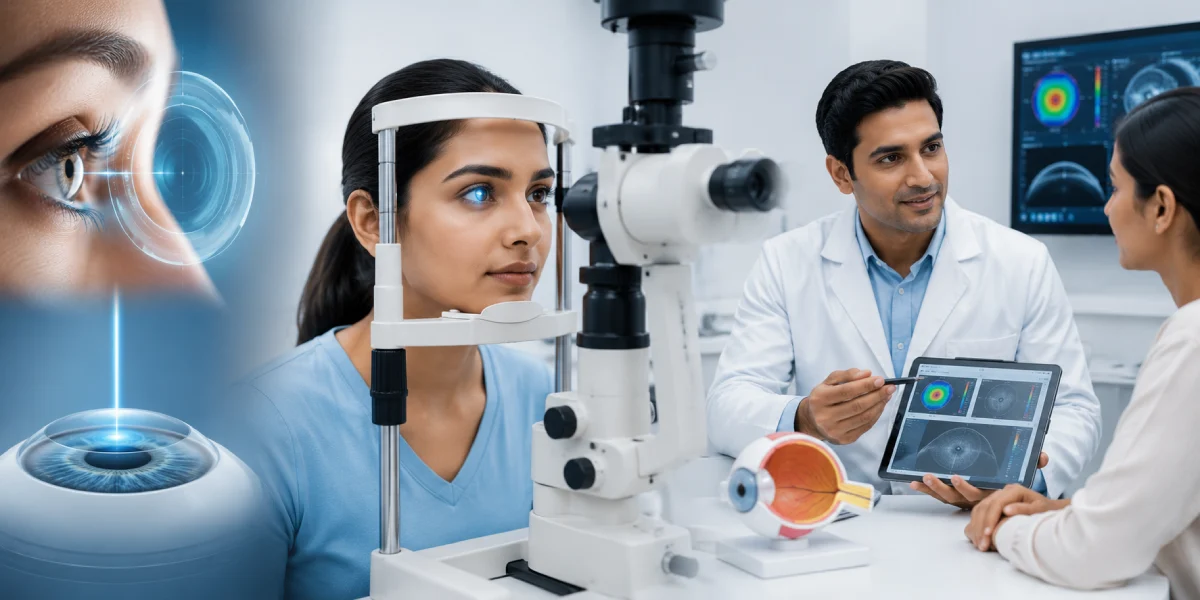
Before we get into the specific criteria, it is worth understanding why candidacy evaluation matters so much.
LASIK is a process where the cornea (the transparent front part of the eye) is altered with an accurately directed laser to correct vision problems. A certain number of cells from the cornea is removed through this surgical process. For LASIK to work safely and effectively, one has to have enough thickness and proper shape of the cornea, among others.
Who Is a Good Candidate for LASIK?
1. Adults Above 18 Years — Ideally in Their Mid-Twenties
Your eyes continue developing and changing through your teenage years and often into your early twenties. LASIK requires a stable, mature cornea — so most surgeons recommend waiting until at least 18, and often suggest that patients in their early twenties allow a little more time if their prescription has been changing recently.
If you are in your thirties or forties and your prescription has been stable, you are often an excellent candidate. Age itself is not a barrier — stability of vision is.
2. Stable Spectacle Prescription for at Least One Year
This is one of the most important criteria. If your glasses or contact lens prescription has been changing — even slightly — from year to year, it suggests your eyes are still shifting. LASIK corrects your eyes as they are today. If they continue to change after surgery, your vision may not remain as sharp as expected.
A prescription that has stayed consistent for at least twelve months is the minimum standard. Two years of stability are even more reassuring.
3. Adequate Corneal Thickness
Because LASIK removes tissue from the cornea, there must be enough thickness to begin with. Thin corneas that cannot safely accommodate the required tissue removal are one of the most common reasons a patient is found to be unsuitable for LASIK — and referred instead for an alternative like ICL surgery or PRK.
Corneal thickness is measured with a simple, painless test called pachymetry during the pre-LASIK assessment.
4. Healthy Eyes — Free From Certain Conditions
LASIK candidates should not have active eye conditions, including glaucoma, significant uncontrolled dry eye disease, corneal infections, or cataracts that require attention.
Dry eye in particular deserves mention here. Mild dry eye does not automatically rule out LASIK, but it needs to be assessed carefully and managed before surgery — because LASIK can temporarily worsen dryness, and for patients whose dry eye is already significant, this can affect both comfort and outcomes. If you experience dry eyes regularly, our detailed guide on dry eyes causes and treatment explains how this is assessed and what can be done before proceeding to laser vision correction.
5. Realistic Expectations About Outcomes
I always spend time on this during consultations, because it matters more than most patients initially realise.
LASIK significantly reduces or eliminates dependence on glasses for the vast majority of patients. Many achieve 20/20 vision or better. But no surgical procedure can guarantee a specific outcome for every individual. Your healing response, the precise characteristics of your cornea, and the nature of your refractive error all influence your result.
Who May Not Be Suitable for LASIK?

The most important thing to understand is that when you are not a good LASIK candidate, it does not mean that vision correction is impossible. It just means that another technique should be applied. For example, ICL surgery, which involves inserting a lens into the eye without excising the corneal tissue, is a great choice for these patients. You can read a full comparison of both options in our guide on ICL surgery for clear vision without LASIK.
What Happens During the LASIK Evaluation?
At Dr. Rishi Eye Institute, every patient considering laser vision correction in Karnal undergoes a detailed pre-LASIK assessment. This typically takes one to two hours and includes:
Corneal topography — a detailed map of the shape and curvature of your cornea, used to identify any irregularities that could affect LASIK safety or outcomes.
Pachymetry — precise measurement of corneal thickness at multiple points.
Dry eye assessment — evaluation of your tear film quality and production.
Dilated retinal examination — a thorough look at the back of the eye to ensure there are no retinal issues.
Intraocular pressure measurement — to screen for glaucoma.
Refraction and best corrected vision testing — to accurately determine your prescription and the maximum vision achievable with correction.
A detailed discussion about your lifestyle, visual requirements, and realistic expectations completes the assessment. Only then is a recommendation made.
Signs You Are Likely a Good LASIK Candidate

- Have worn glasses or contact lenses for at least a year with a stable prescription
- Are above 18 years old — ideally 21 or older if your prescription was still changing recently
- Have no significant dry eye, corneal disease, or active eye conditions
- Lead an active lifestyle where glasses or contacts are inconvenient
- Have realistic expectations and understand that outcomes vary by individual
- Have healthy eyes with adequate corneal thickness
A Final Word
The best way to find out whether you are a LASIK candidate is to come in for a proper evaluation. Not a five-minute conversation, but a thorough, unhurried assessment that looks at your eyes in detail and gives you an honest answer.
At Dr. Rishi Eye Institute, Karnal, we perform comprehensive LASIK evaluations using advanced diagnostic technology, and we counsel every patient honestly about what laser vision correction can realistically achieve for their specific eyes. For a broader overview of everything we offer — from LASIK and ICL to cataract, glaucoma, and retina care — our guide on why Dr. Rishi Eye Institute is Haryana’s trusted eye hospital covers it all.
If you are tired of glasses and want to know whether LASIK is the right step for you — come in. Let your eyes answer the question properly.
📞 Call us: +91-7015680440 📍 1363/64, Sector-6, Karnal, Haryana – 132001

1 Comment
LASIK Surgery Karnal Haryana | Dr. Rishi Eye Institute
[…] alternatives including ICL surgery, PRK, or SMILE, depending on what their eyes need. Our blog on who is the ideal candidate for LASIK eye surgery explains the full evaluation process and what each criterion means in practical […]