
Monofocal vs Multifocal vs Toric Lens: Which IOL Is Right for You?
One of the most important decisions you will make before cataract surgery is one that most patients do not even know they need to make — until they are sitting in a pre-operative consultation. Their surgeon asks: “Which lens would you like?”
The artificial lens that replaces your cloudy natural lens during cataract surgery is called an intraocular lens, or IOL. Choosing the right one is not a small detail. It directly determines how you will see after surgery — whether you will need glasses for distance, for reading, for both, or potentially for neither.
At Dr. Rishi Eye Institute, I spend significant time on this conversation with every cataract patient. Because the best lens for you depends on your lifestyle, your other eye conditions, your expectations, and what you actually do with your eyes every day.
This guide will walk you through the three main IOL categories — monofocal, multifocal, and toric — so you arrive at your consultation informed and ready to make a decision that suits your life.
What Is an Intraocular Lens?

During cataract surgery in Karnal, the cloudy natural lens is removed through a small incision using phacoemulsification — an ultrasonic technique — and replaced with a clear artificial lens. This IOL is permanent. It stays in your eye for the rest of your life, requires no maintenance, and does not wear out.
The type of IOL implanted determines your post-operative visual experience. Getting this choice right matters enormously.
Monofocal Lenses — The Reliable Standard
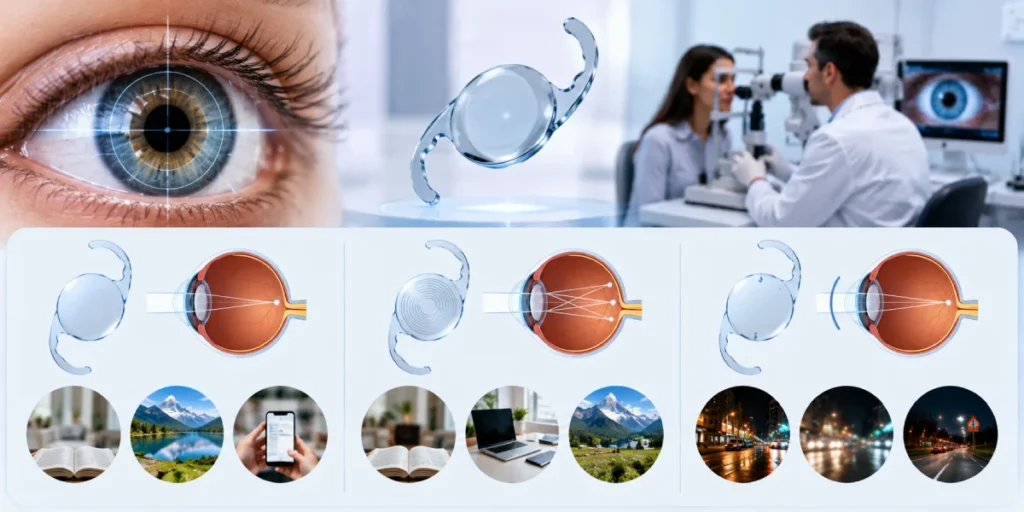
A monofocal lens corrects vision at a single fixed distance. Most commonly, monofocal IOLs are set for distance vision — so you can see clearly for driving, watching television, and most outdoor activities without glasses. You will then need reading glasses for close-up tasks like reading, using your phone, or doing needlework.
Alternatively, some patients choose to have one eye set for distance and one for near — a technique called monovision — which allows the brain to blend the two images and reduce spectacle dependence overall. This works well for some people and not as comfortably for others.
Who benefits most from monofocal lenses?
Monofocal lenses are an excellent choice if you do not mind wearing reading glasses after surgery, if you have other eye conditions — such as macular degeneration or significant corneal irregularity — that might limit the benefit of more complex lenses, or if your budget is a primary consideration, as monofocal lenses are the most affordable IOL option.
They are time-tested, highly predictable, and give excellent distance vision for the vast majority of patients.
Multifocal Lenses — Greater Independence From Glasses

Multifocal IOLs are designed to provide clear vision at multiple distances simultaneously — typically distance, intermediate, and near — by using concentric rings on the lens surface that split incoming light into different focal points.
The appeal is obvious: the possibility of significantly reduced dependence on glasses after cataract surgery. Many patients with multifocal lenses can read, use a computer, drive, and navigate their daily lives without reaching for spectacles at all.
The honest trade-off:
Multifocal lenses work well for many patients — but they do not work identically for everyone. Some patients notice halos or glare around lights, particularly at night, while the brain is adjusting to the new optical system. For most, this settles over the first few months as neuroadaptation occurs. For a small number of patients, it remains bothersome.
Multifocal lenses also require a more precise surgical plan. Residual astigmatism — even a small amount — can reduce the quality of vision with a multifocal IOL more noticeably than with a monofocal. This is why the pre-operative assessment is particularly important if you are considering this lens type.
Who benefits most from multifocal lenses?
Multifocal lenses are ideal for patients who strongly prefer to minimize spectacle dependence after cataract surgery in Haryana, lead active lifestyles that involve switching frequently between near and distance tasks, have healthy maculae and corneas, and are willing to allow a period of adaptation.
Toric Lenses — Precision Correction for Astigmatism
Astigmatism is a very common condition where the cornea is slightly oval rather than spherical, causing blurred or distorted vision at all distances. Standard monofocal and multifocal lenses do not correct astigmatism — so patients with significant astigmatism who receive a standard IOL often still need glasses even after surgery to compensate for the corneal irregularity.
A toric IOL is specifically designed to correct astigmatism at the same time as the cataract is removed. It is a monofocal or multifocal lens with an additional component that compensates for the irregular corneal curvature.
Toric lenses must be precisely oriented during implantation — rotation of even a few degrees can reduce the effectiveness of the astigmatism correction. Modern surgical techniques and intraoperative guidance systems make this placement highly accurate.
Who needs a toric lens?
If you have significant astigmatism — typically above 0.75 to 1.0 dioptres — a toric lens is worth serious consideration. Without it, you are likely to need cylindrical correction in your glasses after surgery. With it, many patients achieve good distance vision without glasses even with pre-existing astigmatism.
Toric lenses are available in both monofocal and multifocal formats — so patients with astigmatism who also want spectacle independence can choose a toric multifocal lens.
How to Choose the Right Lens for Your Eyes

There is no universally correct answer. The right IOL depends on several factors that your surgeon will discuss with you during your pre-operative assessment.
Your lifestyle and visual priorities. Do you drive frequently and need excellent distance vision? Do you read extensively and want to do so without glasses? Do you work on a computer for long hours? Do you play sports or engage in activities where glasses are impractical? Your daily visual demands should guide your lens selection.
Your corneal health. Corneal irregularities, scarring, or conditions like keratoconus can affect how well certain lenses perform. Patients with corneal disease may find that simpler monofocal lenses give more predictable results.
The presence and degree of astigmatism. If your astigmatism is significant, a toric component is important to achieving good unaided vision after surgery.
Your other eye conditions. Macular degeneration, diabetic retinopathy, or significant epiretinal membrane formation can limit the benefit of multifocal lenses. In these cases, a monofocal lens often provides more reliable results.
Your expectations. The most important part of any lens discussion is honesty. No IOL eliminates spectacle dependence for 100% of patients in 100% of situations. Understanding what you can realistically expect from each lens type — including the possibility of needing glasses for some tasks — allows you to make a genuinely informed decision.
Questions to Ask Your Surgeon Before Choosing an IOL
Before your cataract surgery at the best cataract surgeon in Karnal, these are the questions worth asking:
- Based on my eye measurements and lifestyle, which lens do you recommend for me — and why?
- Do I have astigmatism significant enough to benefit from a toric lens?
- Am I a good candidate for a multifocal lens, given my macular and corneal health?
- What are the realistic chances that I will need glasses after surgery with each option?
- What are the potential downsides of the lens you are recommending for my eyes specifically?
A surgeon who answers these questions clearly and honestly — including acknowledging limitations — is one worth trusting. Our guide on early signs of cataract and when to seek treatment is a useful companion read if you are still in the process of understanding your diagnosis.
IOL Choice Is Part of a Larger Plan

Choosing the right IOL is one component of a well-planned cataract surgery. The quality of the pre-operative biometry — the measurements used to calculate your lens power — the surgical technique, and the post-operative care all contribute to your final visual outcome.
At Dr. Rishi Eye Institute, Karnal, we use advanced diagnostic technology for all pre-operative measurements and offer the full range of IOL options — monofocal, toric, multifocal, and toric multifocal — tailored to each patient’s individual needs and circumstances.
For a complete understanding of the cataract surgery process — from diagnosis through recovery — our detailed guide on cataract types, symptoms and treatment covers everything you need to know before your consultation.
We also offer cataract surgery under Ayushman Bharat and ECHS empanelment, making quality treatment accessible to patients across Karnal, Kurukshetra, Panipat, and Haryana regardless of financial circumstance. Our complete guide on why Dr. Rishi Eye Institute is Haryana’s most trusted eye hospital explains the full range of services and support available.
Final Thoughts
The lens choice you make before cataract surgery shapes how you see the world for the rest of your life. It deserves careful thought, honest information, and a surgeon who takes the time to explain your options in terms that make sense for your specific situation.
At Dr. Rishi Eye Institute, Karnal, we believe that informed patients make better decisions — and we take the time to ensure that every patient understands their options before any surgery is planned.
Book Your Appointment
📞 Call us: +91-7015680440
