

Can Cataract Come Back After Surgery? The Complete Answer
This is one of the questions I am asked most frequently after a successful cataract surgery — usually at the one-month follow-up visit, when the patient is seeing clearly for the first time in years and is suddenly worried about losing that clarity again.
“Doctor, can the cataract come back?”
It is a completely understandable concern. You have just had a procedure that gave you dramatically better vision. You do not want that to change. So let me answer this question directly, honestly, and completely — because the full answer is a little more nuanced than a simple yes or no.
The Short Answer — No, a True Cataract Cannot Return
A cataract forms in the natural crystalline lens of your eye — the lens you were born with. During cataract surgery in Karnal, this cloudy natural lens is completely removed and replaced with a clear artificial intraocular lens (IOL). Once your natural lens has been removed, it cannot grow back. The cataract, therefore, cannot return in the same way or in the same location.
The artificial lens that replaces it does not cloud over. It does not age the way a natural lens does. It does not develop protein clumping — the process that caused your original cataract. In this sense, your cataract surgery is permanent and irreversible.
However — and this is the important part — there is a condition called posterior capsule opacification, or PCO, that can develop after cataract surgery and cause symptoms that feel very similar to a returning cataract. Understanding what PCO is, why it happens, and how easily it is treated will give you a complete picture.
What Is Posterior Capsule Opacification?
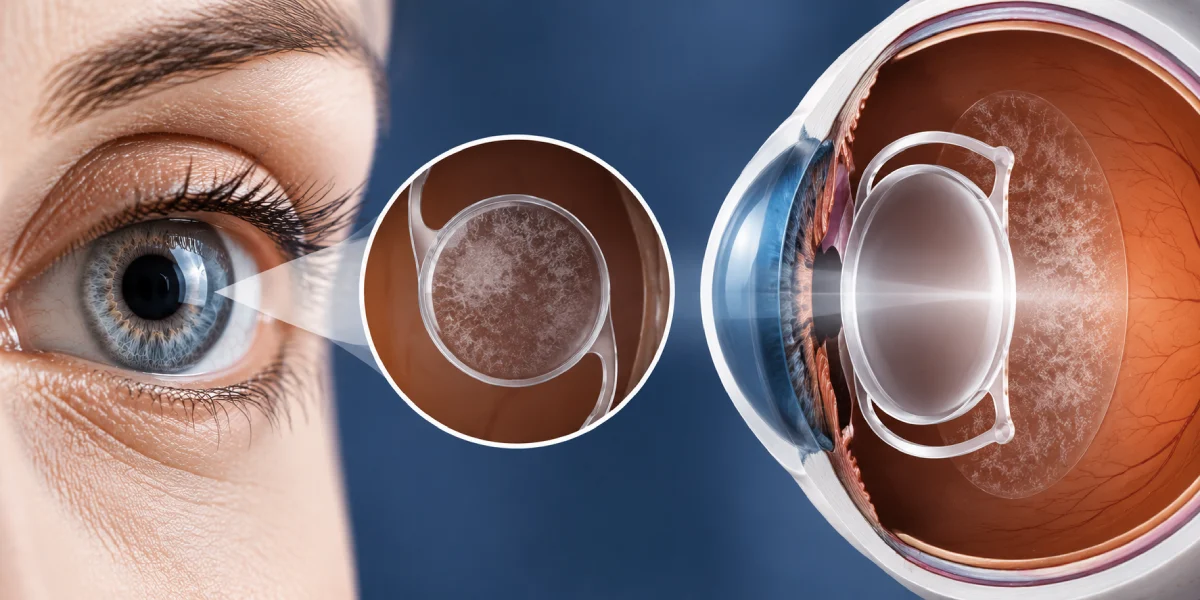
To understand PCO, you need to know a little about how cataract surgery works.
Your natural lens sits inside a thin, transparent membrane called the lens capsule — like a lens sitting inside a clear bag. During cataract surgery, the front of this capsule is opened to access and remove the cloudy lens inside. The back wall of the capsule — called the posterior capsule — is intentionally left in place. The artificial IOL is then placed inside this remaining capsular bag, using it as a stable support structure.
Over time — months or years after surgery — the cells lining the inside of this capsular bag can multiply and migrate onto the posterior capsule. These cells gradually make the capsule cloudy and hazy, reducing the clarity of light passing through to the retina.
When this happens, patients notice symptoms that can feel very similar to the original cataract — blurred or hazy vision, glare, difficulty reading, or reduced contrast sensitivity.
This is not the cataract returning. It is the posterior capsule becoming cloudy — a completely separate and easily treatable condition.
How Common Is Posterior Capsule Opacification?
PCO is the most common complication after cataract surgery, affecting a significant number of patients — estimates vary, but many studies suggest that between 20 and 50 percent of patients develop some degree of PCO within five years of surgery.
The risk varies depending on the type of IOL implanted, the surgical technique used, and individual patient factors including age, the type of cataract that was removed, and certain systemic conditions. Modern square-edged IOL designs have significantly reduced the incidence of PCO compared to older lens designs, but it remains a possibility that every cataract patient should be aware of.
How Is PCO Treated?
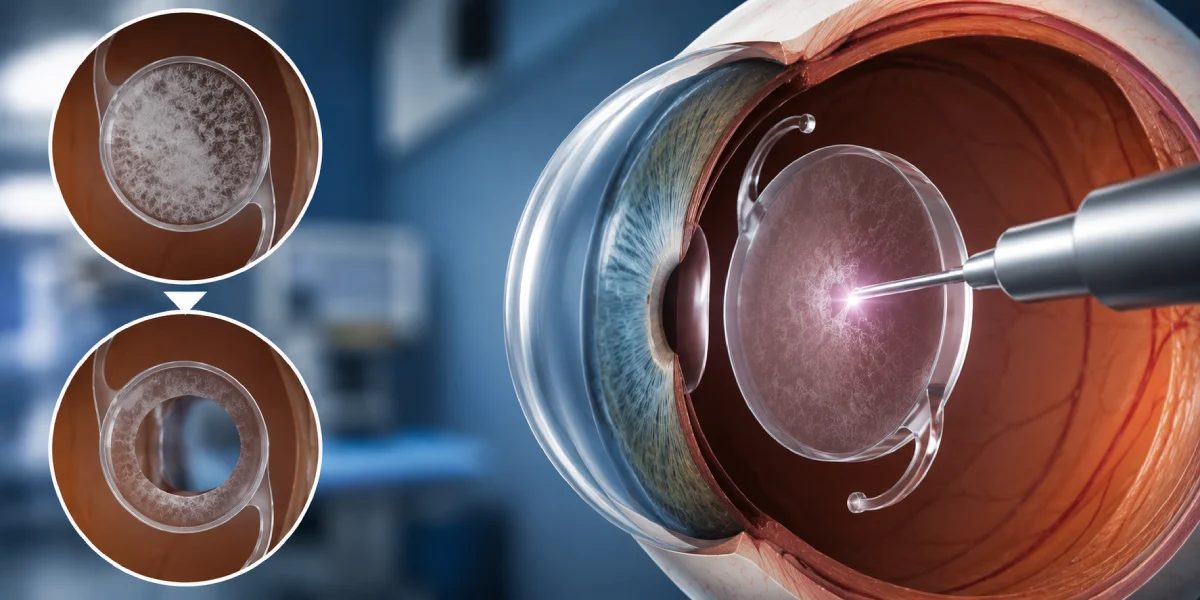
This is the genuinely reassuring part of the story. PCO is treated with a simple, painless, outpatient laser procedure called YAG laser capsulotomy.
During this procedure, a laser creates a small, precise opening in the cloudy posterior capsule — clearing the visual axis and restoring clarity. The entire process takes a few minutes. No injections, no incisions, no hospital admission. You sit at a laser machine, a few laser pulses are applied, and you leave the same day.
Most patients notice an improvement in vision within 24 hours of the procedure. The results are permanent — once the opening is created in the posterior capsule, PCO in that area cannot recur.
YAG laser capsulotomy is one of the most commonly performed procedures in ophthalmology, with an excellent safety profile when performed by an experienced surgeon.
How Do You Know If You Have PCO?
If your vision was clear after cataract surgery and has gradually become hazy or blurred again — particularly if reading has become difficult, glare has increased, or colors seem less vivid — PCO is one of the first things your eye doctor will check for.
The diagnosis is made during a routine slit-lamp examination. Your ophthalmologist will look at the posterior capsule and assess whether cloudiness has developed and whether it is affecting your vision significantly enough to warrant treatment.
This is one of the reasons follow-up appointments after cataract surgery matter — not just in the immediate post-operative period, but in the years that follow. If you notice a gradual return of symptoms similar to your original cataract, do not assume nothing can be done. Come in and get it checked. Our detailed guide on early signs of cataract and vision changes also helps you understand what different types of visual changes mean and when to seek an assessment.
Other Reasons Vision May Change After Cataract Surgery

PCO is the most common reason vision deteriorates after initially successful cataract surgery — but it is not the only one. It is worth being aware of other possibilities so you know when to seek attention.
Refractive surprise — occasionally, despite accurate pre-operative measurements, the IOL power does not result in exactly the expected refraction. In these cases, glasses may be needed for some tasks, or a lens exchange may be considered in selected situations.
Progression of other eye conditions — cataract surgery corrects the cataract, but it does not protect against or treat other conditions. Age-related macular degeneration, glaucoma, diabetic retinopathy, and other retinal conditions can progress after surgery and affect vision independently of the IOL.
Dry eye worsening — cataract surgery can temporarily affect the corneal surface and tear film, exacerbating dry eye symptoms in susceptible patients. This can cause variable, fluctuating vision that is sometimes misinterpreted as a problem with the lens.
IOL dislocation — very rarely, an IOL can shift position over time, particularly in patients with certain systemic conditions or previous eye trauma. This causes a vision change that your ophthalmologist can assess and manage.
When Should You Contact Your Eye Doctor After Cataract Surgery?
You should book an appointment promptly — not wait for your next scheduled visit — if you notice any of the following after cataract surgery:
- Vision that was clear and has gradually or suddenly become hazy or blurred
- A significant increase in glare or halos that was not present soon after surgery
- Difficulty reading that has worsened progressively
- Any sudden change in vision — loss of clarity, new floaters, flashing lights, or a shadow across any part of your visual field
Sudden changes in particular should be treated as urgent — they can indicate retinal conditions that need prompt attention. For a broader understanding of the eye conditions that require urgent care, our guide on why Dr. Rishi Eye Institute is Haryana’s most trusted eye hospital covers what we treat and how to access emergency eye care.
Protecting Your Vision After Cataract Surgery

While PCO cannot always be prevented, certain habits support the best possible long-term outcomes after cataract surgery in Haryana.
Attending all scheduled follow-up appointments — including annual check-ups in the years after surgery — allows your surgeon to monitor for PCO, track the health of your retina, and manage any other conditions that may develop. Wearing UV-protective sunglasses outdoors reduces cumulative sun damage to the remaining ocular structures. Controlling blood sugar carefully if you have diabetes protects your retina and reduces the risk of PCO-related complications. And maintaining overall eye health through regular comprehensive check-ups is the single most important habit you can build.
For patients who had cataract surgery and want to understand what ongoing eye care looks like, our guide on how often you should get a comprehensive eye checkup provides a clear framework for different age groups and risk profiles.
Final Thoughts
The cataract itself cannot come back after surgery — the natural lens that formed it has been permanently removed. But posterior capsule opacification can develop and cause similar symptoms, and it is important to know that this condition is easily and effectively treated with a simple laser procedure.
The message I want every cataract patient to take from this guide is straightforward: if your vision deteriorates after initially successful cataract surgery, do not assume you simply have to accept it. Come in. Get it checked. In most cases, the solution is simpler than you think.
At Dr. Rishi Eye Institute, Karnal, we provide comprehensive cataract care — from initial evaluation and surgery through to long-term follow-up — for patients across Karnal, Kurukshetra, Panipat, and Haryana.
📞 Call us: +91-7015680440 📍219, Sector-6, Karnal, Haryana – 132001
