

How Squint Affects a Child’s Confidence and Learning
I want you to imagine something for a moment. Your child comes home from school quieter than usual. They have stopped raising their hand in class. They avoid group photos. And when you ask them what is wrong, they shrug and say nothing — but you know something has changed.
For many parents, this is the moment they realise that their child’s squint — the misaligned eye that they had been told was “just cosmetic” or “something they might grow out of” — is doing far more damage than they thought. Not just to their vision, but to their confidence, their friendships, and their ability to learn.
In this blog, I want to talk honestly about what squint actually does to a growing child — and why early squint treatment in Karnal is one of the most important decisions you can make for your child’s future.
What Is Squint and Why Does It Happen?
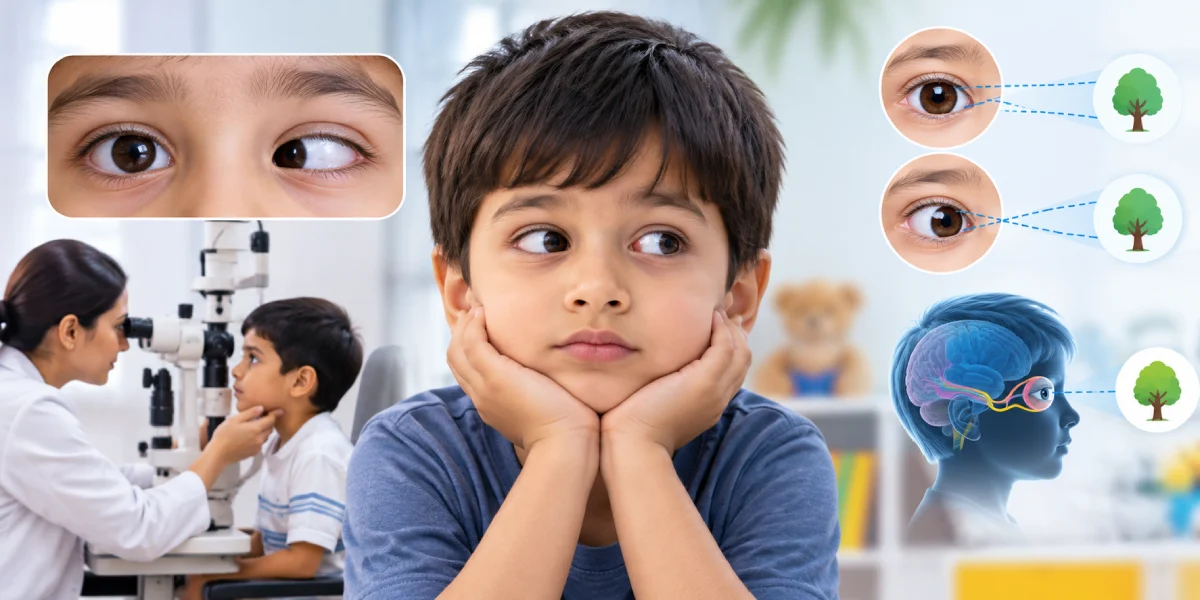
Squint — medically known as strabismus — is a condition where the two eyes do not align properly. One eye may turn inward, outward, upward, or downward while the other eye looks straight ahead. This misalignment can be constant or may come and go at certain times of the day.
Squint in children can develop due to:
- Unequal refractive errors between the two eyes
- Weakness or imbalance in the eye muscles
- Neurological conditions affecting eye movement
- Family history of squint or amblyopia
- Uncorrected long-sightedness, especially in young children
One of the most important things to understand is that squint rarely resolves on its own. Waiting and watching is rarely the right approach — especially in young children whose visual systems are still developing.
How Squint Affects Your Child’s Vision
When a child has a squint, their brain receives two different images — one from each eye — that do not match up. To avoid the confusion this causes, the brain does something remarkable: it simply starts ignoring the image from the misaligned eye. Over time, this suppression weakens the vision in that eye, leading to a condition called amblyopia or lazy eye.
Amblyopia is not just about a weak eye — it means that even with the best glasses or contact lenses, that eye cannot achieve normal vision unless the condition is treated during the critical window of visual development, typically before the age of 7 to 8 years.
Beyond amblyopia, children with untreated squint also lose binocular vision — the ability to use both eyes together to perceive depth and three-dimensional space. This affects everything from catching a ball to reading text on a board to judging distances while crossing the road.
The Hidden Impact on Classroom Learning
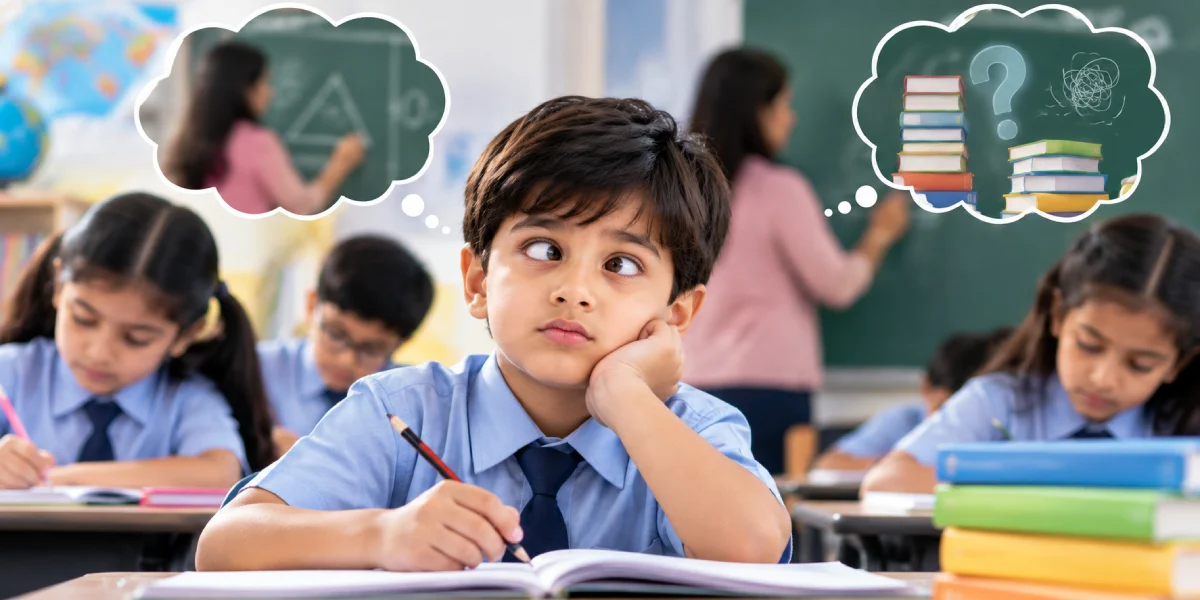
Here is something most parents do not realise: many children with squint struggle academically — not because they are not intelligent, but because their vision makes learning genuinely harder.
Reading and Writing
A child with reduced binocular vision may lose their place while reading, skip lines, or find it difficult to maintain focus on text for extended periods. Writing neatly within lines requires accurate depth perception — something children with untreated squint often struggle with without understanding why.
Blackboard and Screen Vision
When one eye is significantly weaker or turned, a child may strain to see what is written on the board, leading to headaches, eye fatigue, and difficulty concentrating in class. Teachers sometimes interpret this restlessness as a behavioural issue rather than a vision problem.
Sports and Physical Activities
Catching a ball, judging distances in games, and navigating a crowded playground all require good depth perception. Children with squint often avoid sports and physical activities — not because they are uninterested, but because these activities are genuinely more difficult and frustrating for them. You should also ensure your child has a comprehensive eye checkup done regularly to catch any developing vision issues early.
The Confidence and Social Impact Nobody Talks About
The emotional impact of squint on children is real, significant, and often overlooked in medical conversations. Children are perceptive — and unfortunately, so are other children.
Research consistently shows that children with visible squint are more likely to experience teasing and social exclusion from peers. Over time, this can lead to:
- Reduced self-confidence and self-esteem
- Avoidance of eye contact during conversations
- Withdrawal from social situations and group activities
- Reluctance to participate in class or raise their hand
- Anxiety about being noticed or pointed out in public
- Negative impact on friendships and peer relationships
I have seen children in my clinic who have completely changed personality because of squint — from confident, talkative children to quiet, withdrawn ones. In some cases, the parents did not even connect the two. They thought their child was just going through a “phase.”
Why Early Treatment Changes Everything
The single most important fact about squint treatment is this: the earlier you act, the better the outcome — for both vision and confidence.
During the first 7 to 8 years of life, the brain is still actively developing its visual pathways. Treatment during this critical window — whether through glasses, patching therapy, or squint surgery in Karnal — can restore proper eye alignment, allow normal binocular vision to develop, and prevent or reverse amblyopia.
After this critical period, treatment becomes significantly less effective. Waiting — in the hope that the squint will correct itself, or that the child will “manage” — is one of the most common reasons children end up with permanent vision loss that could have been prevented.
What Does Squint Treatment Involve?
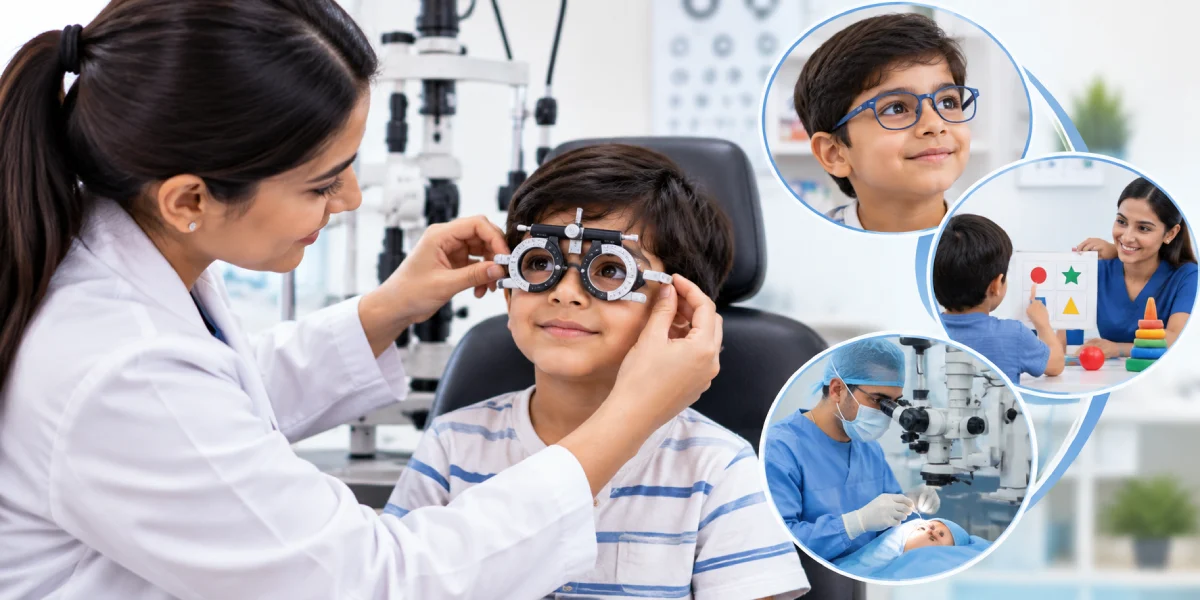
Treatment depends on the type, severity, and cause of the squint. It may include one or a combination of the following:
Glasses
In many children, particularly those with long-sightedness, the correct spectacle prescription significantly reduces or eliminates the squint without any further intervention.
Patching Therapy
If amblyopia has developed, patching the stronger eye for a few hours daily encourages the weaker eye to work harder and develop better vision. This is most effective in younger children and requires consistency and patience from both the child and the family.
Squint Surgery
When glasses and patching are not sufficient to correct the alignment, squint surgery is recommended. The procedure involves adjusting the tension in the eye muscles to realign the eyes. It is performed under general anaesthesia in children and is a safe, well-established procedure with excellent outcomes when done by an experienced ophthalmic surgeon. You can learn more about our full range of treatments on our squint treatment services page.
When Should You Bring Your Child In?
Do not wait for an obvious, constant turn in the eye. You should book an eye examination for your child if you notice:
- One eye appears to turn in, out, up, or down — even occasionally
- Your child frequently squints or tilts their head to see clearly
- They close one eye in bright sunlight
- They seem to struggle with reading, writing, or schoolwork without a clear reason
- They complain of headaches or tired eyes after school
- They have become unusually withdrawn or self-conscious
- There is a family history of squint or lazy eye
Even if you are not sure, an eye examination will give you clarity. It is always better to check and be reassured than to wait and miss the window for treatment.
Give Your Child the Vision and Confidence They Deserve
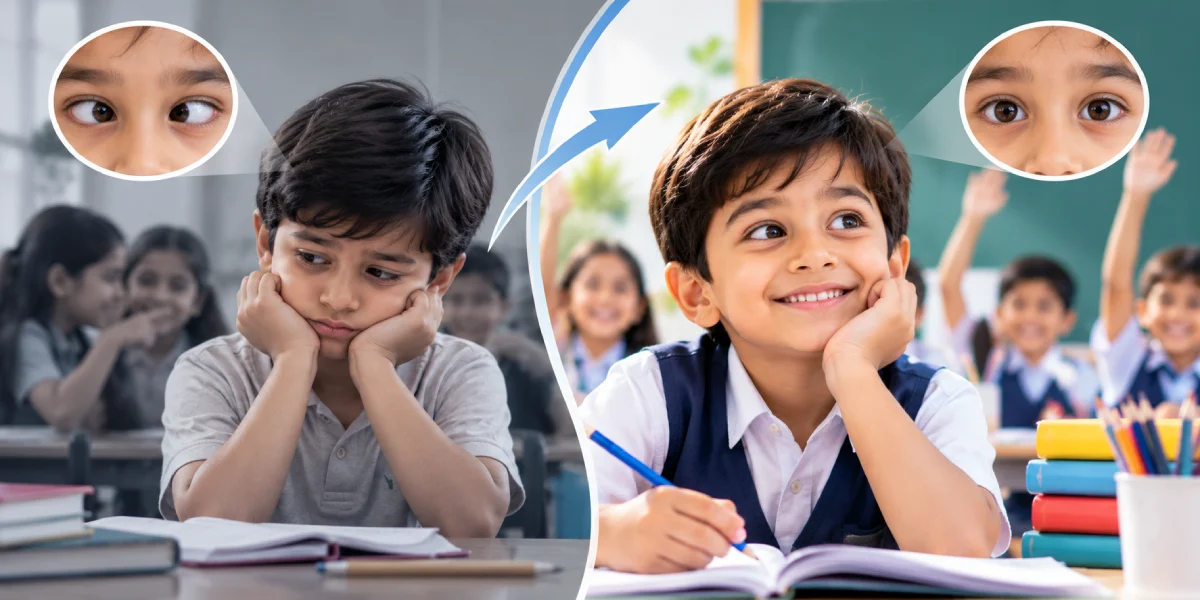
Squint is not just a cosmetic issue. It is a medical condition that affects how your child sees the world, how they perform at school, and how they feel about themselves. The good news is that with timely treatment, the outcomes are genuinely excellent — better vision, better confidence, and a child who can fully participate in everything life has to offer.
If you have any concerns about your child’s eyes — however small they may seem — please do not put it off. At Dr Rishi Eye Institute, we are open 7 days a week, walk-ins are always welcome, and our team is experienced in the diagnosis and treatment of squint in children of all ages.
Book your child’s eye examination today — because the best time to treat squint is always now.
 Call us: +91-7015680440
  219, Sector-6, Karnal, Haryana – 132001
