
ICL Surgery: See Clearly Without LASIK or Glasses
Let me tell you about a patient I saw recently. She had been wearing thick glasses since she was twelve years old. By the time she came to see me at Dr Rishi Eye Institute, her power had crossed minus nine — far too high for LASIK. She had almost given up on the idea of clear vision without glasses.
Then we talked about ICL surgery.
Three weeks after her procedure, she called the clinic. She said she could read the time on a clock across the room without reaching for her glasses. That moment is exactly why I believe every person with high spectacle power deserves to know about this option.
If you have been told you are “not suitable for LASIK” — please read this carefully. ICL surgery might be the answer you have been looking for.
What Exactly Is ICL Surgery?

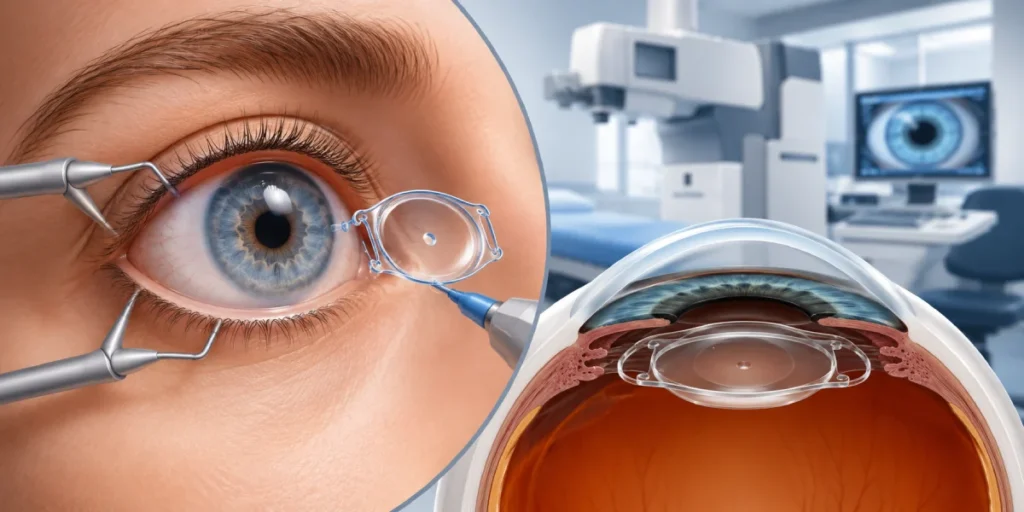
ICL stands for Implantable Collamer Lens. This is an eye procedure where an implantable contact lens, specifically made for your eye and very thin, is inserted into your eye, precisely in between your lens and your iris.
In contrast to LASIK surgery, where a laser is used to reshape the corneal surface, this eye procedure does not involve the manipulation or removal of any corneal tissue at all. The lens simply works alongside your natural eye structures to bring the world into focus.
It corrects:
- Myopia (nearsightedness) — including very high powers
- Astigmatism — using a special toric ICL lens
- Hyperopia (farsightedness) — in selected cases
Who Is a Good Candidate for ICL Surgery?
This is the question I get asked most often. You may be a good candidate if:
- Your spectacle power is high — especially myopia above minus six
- Your corneas are thin, and LASIK has been ruled out
- You suffer from dry eyes, which makes laser procedures less comfortable
- You are between 21 and 45 years of age with stable eye power
- You want a long-term alternative to contact lenses
The only way to know for certain is a detailed eye examination. If you are unsure whether ICL is right for you, I would strongly recommend visiting an experienced eye specialist in Karnal for a thorough evaluation before making any decisions.
How Is the Surgery Done?
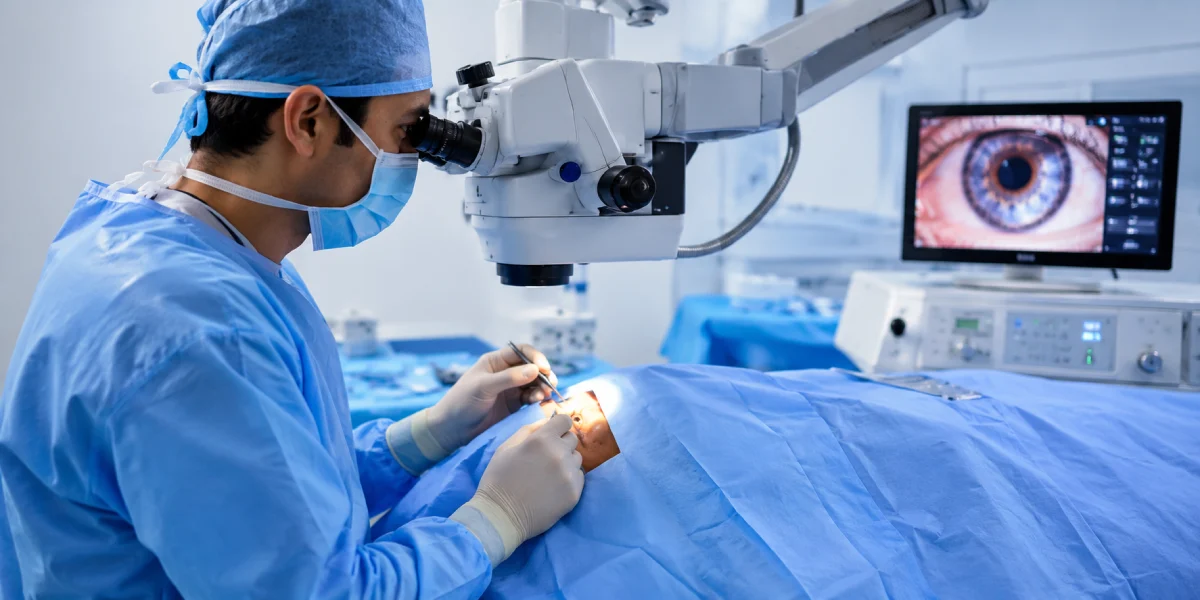
Many people are surprised by how straightforward the procedure is. ICL surgery typically takes 20 to 30 minutes and is performed under local anaesthetic eye drops — no general anaesthesia, no overnight hospital admission.
Here is what happens:
- Detailed eye measurements are taken in the days before surgery
- On the day of surgery, anaesthetic drops are applied to your eye
- A tiny incision — smaller than three millimetres — is made at the edge of the cornea
- The folded ICL lens is inserted through this incision and carefully positioned inside the eye
- The incision self-seals without stitches in most cases
- You go home the same day
Most patients notice a significant improvement in their vision within the first 24 to 48 hours. Full stabilisation may take a few weeks.
Why Do Patients Choose ICL Over LASIK?
This is a fair question — and the honest answer is that neither procedure is universally better. They suit different people. But ICL has some advantages that are worth knowing:
It works for high powers. LASIK has limits on how much power it can correct. ICL can handle powers that laser surgery simply cannot.
It preserves your cornea. No tissue is removed. If you ever need a different procedure in the future, your options remain open.
It is reversible. If your vision changes significantly — or if a better technology becomes available — the ICL can be removed or replaced. LASIK cannot be undone.
It reduces dry eye risk. Because no corneal nerves are cut, ICL is often preferred for people who already experience dry eye symptoms.
If you are wondering how ICL compares to laser procedures, our detailed page on LASIK eye surgery in Karnal explains both options clearly to help you make the right decision.
What About Recovery?

Recovery from ICL surgery is generally smooth and faster than most people expect.
In the first few days:
- Use prescribed eye drops exactly as directed
- Avoid rubbing your eyes
- Stay away from dusty environments and swimming pools
- Wear sunglasses outdoors
Some patients notice mild glare or halos around lights in the early weeks — this is normal and usually settles as your eyes adjust to the new lens.
Follow-up appointments are important. We typically see patients the day after surgery, then at one week and one month. These visits help us confirm that your vision is stabilising as expected and that the lens is sitting perfectly.
Are There Any Risks?
Like any surgical procedure, ICL surgery carries some risks. These include a temporary rise in eye pressure, rare infection, mild glare or halos, or, in uncommon cases, early cataract formation. However, with proper patient selection and experienced surgical care, serious complications are rare.
The key is choosing the right surgeon and having a thorough pre-operative evaluation. If you are not a suitable candidate, a good surgeon will tell you — and explore other options with you.
What Does ICL Surgery Cost?
The cost of ICL surgery varies depending on the type of lens used, the technology available at the facility, and whether one or both eyes are being treated. It is generally more expensive than cataract surgery — but for patients who are not LASIK candidates, it is often the only effective surgical option available.
Many patients tell me that after years of spending on glasses, contact lenses, solutions, and regular check-ups, the long-term value of ICL surgery makes it a worthwhile investment. The freedom from glasses can genuinely change how you experience everyday life.
Is ICL Surgery Right for You?

That is a question only a proper eye examination can answer. All that I can say is that if you have strong spectacle power, if you have been told that LASIK surgery is not an option for you, or if you simply want to stop wearing glasses or lenses altogether, then you definitely need to consider ICL surgery. Dr Rishi Eye Institute in Karnal is one place that offers comprehensive evaluation and surgery services for ICL treatment to all patients in Karnal, Kurukshetra, Panipat, and Haryana.
Come in for a consultation. You might be closer to a clear vision than you think.

2 Comments
LASIK Surgery Cost In Karnal | Dr. Rishi Eye Institute
[…] and at that boundary, alternative procedures like ICL surgery may be more appropriate. Our guide on ICL surgery for vision correction without LASIK explains this alternative in detail for patients who fall outside the standard LASIK […]
Eye Care in Karnal: Always Open, Dr. Rishi Eye Institute
[…] we also understand that some patients prefer to plan ahead — especially for procedures like ICL surgery, cataract evaluation, or a comprehensive eye check-up. For those patients, booking in advance is […]